Rug Encyclopedia · Persian Rugs
A Persian rug is an oriental rug hand-knotted in Iran — the deepest and most celebrated weaving tradition in the world, from fine curvilinear city rugs to bold tribal and village weaves. "Persian" names the country of origin; the design tells you the city or tribe. This hub is your map to every Persian rug we carry, and how to choose one.
What is a Persian rug?
A Persian rug is a rug hand-knotted from wool, silk or cotton in Iran (historically Persia), using the asymmetrical (Persian) knot that allows the fine, flowing, curvilinear designs Persian weaving is famous for. Every genuine Persian rug is made by hand, one knot at a time, so the pattern lives in the pile and reads clearly on the back. The name refers to the country of weaving — Iran — while the specific design tradition (Kerman, Tabriz, Heriz) tells you the city, region or tribe it comes from. At Arteverk, each rug's true origin is stated on its page; look for Origin: Iran to confirm a genuine Persian piece.

Persian rug, or Persian design? The distinction that matters most
This is the single most useful thing to understand before buying, and most rug sites blur it.
A Persian rug is woven in Iran. Persia is the historical name for Iran, and a genuine Persian rug — a Tabriz from Tabriz, a Kashan from Kashan — comes from there. We carry those, and most of ours are vintage or antique pieces we have sought out and acquired, not new production. The Malik family are curators of these rugs: we find them, we restore them, we do not weave them.
A Persian design is something else. The great Persian patterns — Tabriz, Heriz, Kashan, Sultanabad, Mahal, Sarouk — are woven today by superb hand-knotters in Afghanistan, Pakistan and India. These are real hand-knotted rugs made by real weavers in a living tradition. They are simply not from Iran, and we will never let you think they are.
So on every product page you will find the design named separately from the country: “hand-knotted in Afghanistan, in the Heriz tradition” rather than “a Heriz rug.” It is a small difference in wording and an enormous one in meaning — and it is also what US labelling rules ask of any seller, since a style name used where a customer would read it as origin is treated as deceptive.
Neither is the better rug. A new Afghan-woven Sultanabad can be a magnificent thing, and it costs a fraction of a nineteenth-century original. But you should always know which one you are being sold.
Antique, semi-antique, vintage — and how age is actually established
Our oldest and most valuable pieces sit here: genuine antique, semi-antique and vintage Persian rugs, curated for the showroom. These are the rugs people travel to see.
The words have meanings, and we use them strictly. In US customs terms an antique is a piece over one hundred years old — that is a real threshold, not a mood. Semi-antique and vintage describe younger pieces with genuine age and wear. We do not apply any of these words to new production, no matter how convincingly a new rug has been finished to look old.
How does anyone actually date a rug? Not by how faded it looks — a new rug can be washed to look a century old, and that practice is nearly as old as the export trade itself. Real dating rests on harder evidence: structure, wear patterns that follow how a rug was actually used, provenance, and where possible dye chemistry. Synthetic dyes carry dates: synthetic alizarin was not made until 1868, Prussian blue reached Ottoman-region textile dyeing around 1810, and Scheele’s green appears from 1775.1 A dye that did not exist yet is one of the few facts in this trade that cannot be argued with.
How old is the Persian carpet really? An honest answer
You will read that Persian carpets go back five thousand years. The truthful version is more interesting than the round number.
The written record is genuinely ancient. Xenophon mentions Persian carpets as luxury diplomatic gifts around 400 BCE. The surviving carpets are not. No Persian pile carpet can definitely be said to survive from before the sixteenth century CE — apart from Sasanian-era fragments from Shahr-e Qumis.1 Nothing survives from the Achaemenid, Seleucid or Parthian periods at all. So there is a documentary tradition stretching back millennia and a physical one that begins, for practical purposes, with the Safavids.
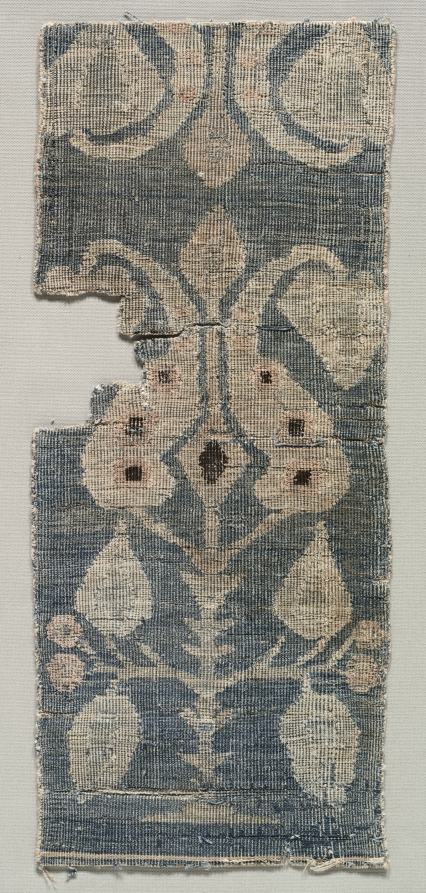
And the famous exception is not what it is usually said to be. The Pazyryk carpet — excavated from a frozen Scythian burial in the Altai and dated to the late fourth or early third century BCE — is routinely described as the world’s oldest Persian carpet. Encyclopædia Iranica states that it “has often been erroneously identified as ‘Persian,’ even by its own excavator”, notes that the burial’s date does not correspond to the Achaemenid period, and argues on stylistic grounds for manufacture in Central Asia or Siberia.2 Other scholars have argued for Armenian workmanship. It is a magnificent object and a genuine landmark in the history of weaving. It is not securely Persian, and it is not even the oldest — a knotted fragment from Bashadar, roughly a century earlier, is finer still.2
We say this because the alternative is to repeat a claim we cannot support, and because the real history stands perfectly well without it.
The Safavid summit — and how little is actually known
The Safavid era produced the carpets that anchor every major museum collection. It also produced a scholarly problem that the trade rarely admits: of an estimated 1,500 to 2,000 surviving Safavid carpets, only five carry a date.1 Attributing the rest to a particular city is, in Friedrich Spuhler’s words, “purely hypothetical.”1
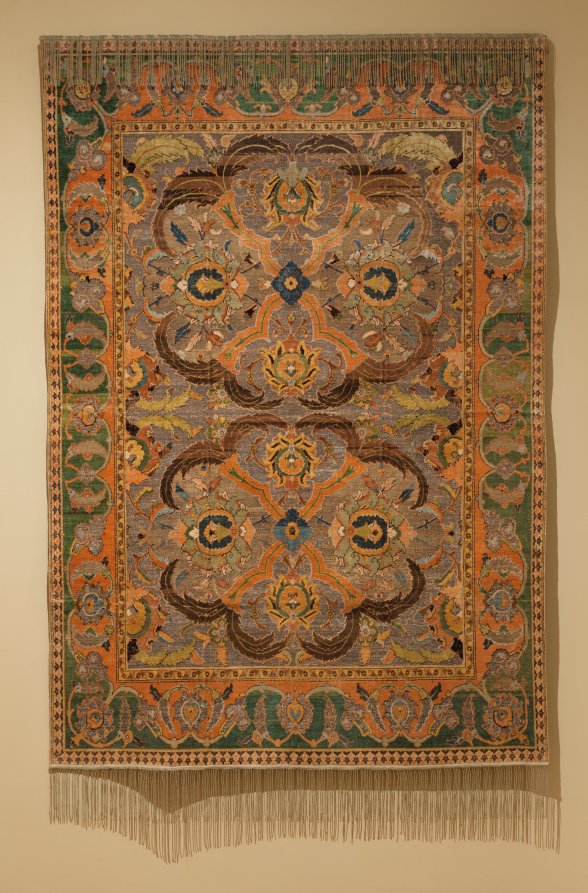
The Ardabil Carpet shows how careful the best scholarship is. Held by the Victoria and Albert Museum (museum no. 272-1893), it is inscribed with the date 946 AH — 1539–40 CE and a signature naming Maqsud Kashani. It carries roughly 340 knots per square inch, wool pile on a silk foundation, asymmetrical knot open to the left.3 And yet the V&A itself states plainly that it is not known for certain who commissioned it, or where it was woven. Its medallion is “usually associated with Tabriz” — an attribution of style, not a record of fact.3
There is one more detail worth knowing, because it says something about how objects reach us. The Ardabil has a twin, now at LACMA, and in the nineteenth century pieces were cut from the twin to repair this one before both were sold.3 The most famous carpet in the world is partly made of its own sibling.
Why this matters when you are buying. If specialists will not attribute an undated masterpiece to a city, be sceptical of anyone who attributes a rug to one with total confidence. The cautionary case is the “Salting group”, long held to be sixteenth-century Persian until Kurt Erdmann reattributed it to nineteenth-century Turkey.4 Three centuries and a country, on the strength of how the carpets looked.
Which is why serious attribution rests on structure, not pattern — knot type, materials, weave — as the Metropolitan Museum states directly.5 A design can be copied anywhere. A weave records where it was made.
Where the Persian carpet comes from
Persian weaving is the deepest and best-documented tradition in the field, and its high point is the Safavid era, when court workshops produced carpets of a refinement that has never really been surpassed — the pieces that anchor the collections of the Metropolitan Museum, the Victoria and Albert, and every other major holding.
Its most commercially consequential chapter, though, is more recent and much less romantic. In the 1870s and 80s, a Manchester firm called Ziegler & Co. organised carpet production at Sultanabad — now Arak — and did something new: it altered palettes, sizes and designs to the specifications of Western retailers, and sold through Liberty, W.J. Sloane and Bon Marché.2 The softened, open-field look that the world now thinks of as classically Persian was, in significant part, designed for Western rooms — and the standard sizes still used across the industry, 3×5, 4×6, 8×10, 9×12, were fixed by that same operation.2
It is a better story than the myth, and it explains something real: why a Persian rug so often looks as though it was made for a Western drawing room. Frequently, it was. See our Ziegler guide for the full account.
Sources
1. Dating markers from published HPLC dye-analysis of Ottoman-region textiles; see the dye studies surveyed in our natural dyes guide.
1. Encyclopædia Iranica, “CARPETS i. Introductory Survey.” iranicaonline.org/articles/carpets-i
2. Encyclopædia Iranica, “CARPETS vi. Pre-Islamic Carpets” (Karen S. Rubinson). iranicaonline.org/articles/carpets-vi
3. Victoria and Albert Museum, The Ardabil Carpet, museum no. 272-1893.
4. Encyclopædia Iranica, “CARPETS ix. Safavid Period” (Daniel Walker).
5. The Metropolitan Museum of Art, “Carpets from the Islamic World, 1600–1800” (Marika Sardar).
6. Encyclopædia Iranica, “CARPETS xi. Qajar Period”; and Ittig, A., “Ziegler’s Sultanabad Carpet Enterprise,” Iranian Studies 25(1–2), 1992, pp. 103–135.
City, village & tribal — the three kinds of Persian rug
- City rugs — the finest, most detailed Persian rugs, woven in workshops from cartoons: Kerman, Tabriz, Kashan, Nain. Curvilinear medallions, dense floral fields, high knot counts.
- Village rugs — bolder, semi-formal weaves from settled villages: Heriz, Bijar, Hamadan, Sultanabad. Geometric medallions, sturdy construction.
- Tribal rugs — woven from memory by nomadic and pastoral weavers: Gabbeh, Bakhtiari, Lori. Spontaneous, symbolic, one of a kind.
Explore Persian rugs by origin
Each Persian weaving centre has its own in-depth guide — history, motifs, how to identify it, and how to choose one:
Shop the full Persian collection, or browse the complete rug encyclopedia.

The Persian knot & how Persian rugs are made
Persian rugs are hand-knotted on a cotton or silk foundation, most often with the asymmetrical (Persian, or Senneh) knot, which wraps around one warp thread and passes loosely behind the next — ideal for the fine, curved lines of floral and medallion designs. Knot counts range from a few hundred per square inch in village rugs to well over a thousand in fine city and silk rugs. Learn the detail in our how a rug is made and knot count guides.
Classic Persian motifs
- Medallion — a central sunburst or lobed medallion on an open or floral field; the signature Persian city layout.
- Herati (mahi / "fish") — a repeating diamond-and-leaf motif; the most widespread Persian all-over pattern.
- Boteh (paisley) — the teardrop seed-and-flame of fertility and life, from tribal to city rugs.
- Tree of life & garden — pictorial and paradise-garden designs symbolising eternal life.

Hand-knotted vs machine-made — labeled honestly
A genuine Persian rug is hand-knotted in Iran, one knot at a time — durable, repairable and one of a kind. Machine-made and power-loomed rugs can copy a Persian design but are woven by machine and are not true Persian rugs. At Arteverk, hand-knotted Persian rugs are the heart of what we do, and any power-loomed piece is always labeled power-loomed — the Construction and Origin fields on every product page state exactly what it is.
How to choose a Persian rug
Work in three steps: size, palette, then origin. Measure your room and choose a size that anchors the furniture — our rug size guide gives the exact method, and Arteverk carries sizes from scatters and runners to oversize and palace pieces of 12'×15' and larger. Pull a color from your scheme (browse by red, blue, ivory). Then choose the tradition — fine and formal (Kerman, Tabriz, Kashan) or bold and characterful (Heriz, Gabbeh, Bakhtiari).
Caring for a Persian rug
A hand-knotted Persian rug lasts generations: vacuum gently with the pile and never the fringe, rotate every 6–12 months, use a rug pad, and blot spills immediately. Have it professionally hand-washed by a wool-rug specialist every few years. Our full rug care guide covers everyday care, spills, moths and storage.
- Genuine, origin-stated pieces. Our Persian rugs are predominantly hand-knotted in Iran, with each rug's real origin stated on its page — the collection the trade has relied on for fifty years, now direct to you.
- Real makers & curators. The Malik family — third-generation weavers and curators who commission, curate and restore hand-knotted rugs.
- The exact piece you see. Every hand-knotted rug is photographed as the single, one-of-a-kind rug you'll receive; any power-loomed piece is labeled plainly.
Find your Persian rug
Browse our hand-knotted Persian collection, or tell us your size and colors and we'll hand-pick a few one-of-a-kind pieces for you.
Frequently asked questions about Persian rugs
What is the difference between a Persian rug and an oriental rug?
All Persian rugs are oriental rugs, but not all oriental rugs are Persian. "Oriental" covers the whole hand-knotted tradition from Turkey and the Caucasus through Iran to Afghanistan, Pakistan and Central Asia; "Persian" refers specifically to oriental rugs hand-knotted in Iran.
Are all Persian rugs made in Iran?
A genuine Persian rug is hand-knotted in Iran (historically Persia). Rugs woven elsewhere in a Persian design are "Persian-style," not true Persian. At Arteverk each rug's real origin is stated on its page — look for Origin: Iran.
How can I tell if a Persian rug is authentic and hand-knotted?
Check the back — the pattern shows clearly and individual knots are visible on a hand-knotted rug; a uniform, gridded or glued back means machine-made. Look for natural-dye abrash, hand-spun wool, and a fringe that is the warp itself, not a sewn strip.
Which Persian rugs are the most valuable?
Fine city and silk rugs (Kerman, Tabriz, Nain, Qum) and documented antiques command the highest prices, driven by knot density, drawing quality, wool and dye quality, age, provenance and condition — the same factors on our Rug Value Ladder.
What size Persian rug do I need?
Match the rug to the room so it anchors the furniture — usually 8'×10' or larger for a living room. Arteverk carries sizes from scatters and runners up to oversize and palace pieces of 12'×15' and larger. See the rug size guide.
Shop Persian rugs by type & colour
Live collections of one-of-a-kind rugs currently in stock.
Every Persian weave we carry
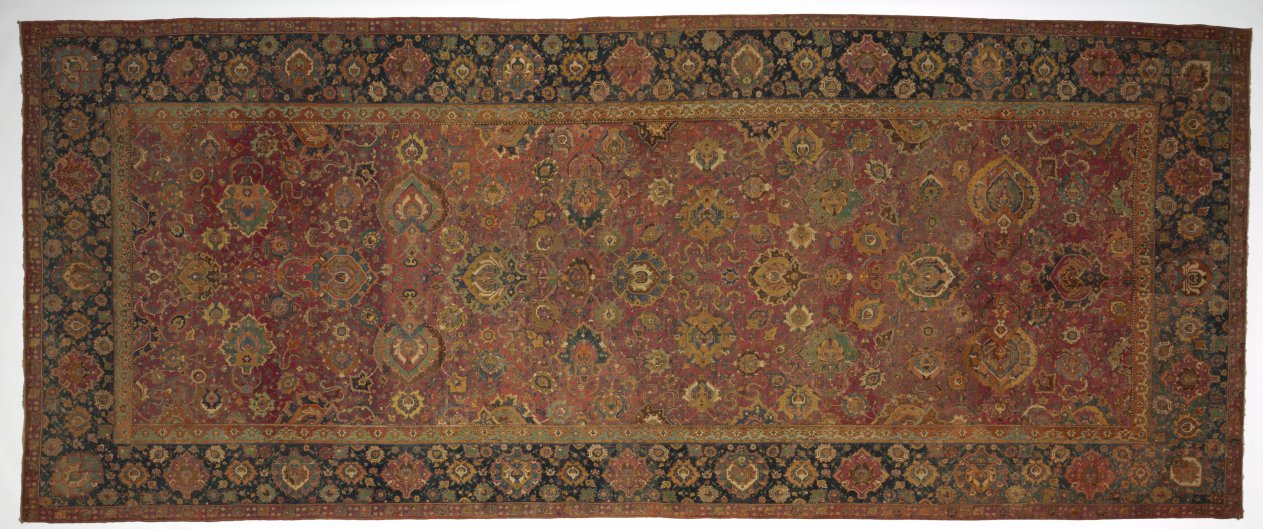
Persia is not one weaving tradition but dozens, and the differences are regional, technical and real. These are the weaves in our own collection — grouped by where they come from, with the pieces we currently hold.
North-west Iran — the largest weaving region
Hamadan is our deepest Persian holding. Hamadan is less a single weave than an enormous village-weaving district around the ancient city of Ecbatana, and its rugs are characteristically single-wefted — a structural signature you can read on the back — which makes them firm, flat and famously hard-wearing.
Tabriz is the great commercial city weave of the north-west and one of the few Persian centres that uses the symmetrical knot rather than the asymmetrical one. Its Mahi — “fish” — pattern is among the most recognisable in the whole field. We also carry Tabriz Fine and Tabriz Herati.
Heriz weaves the bold, angular medallion that decorators reach for when a room needs a single strong gesture — famously durable, thanks to a robust wool and a coarser, sturdier weave than the city rugs.
Bijar rugs are known as the iron rugs of Persia: Kurdish-woven, exceptionally dense and heavy, packed so tightly that they resist folding. We hold Bijar and Bijar Fine.
Also from the region: Bakshaish, Karaja, Senneh, Malayer, Sarab, Navahand, Bibikabad and Hosseinabad.
Central Iran — the classical city weaves
Kashan was a Safavid silk-weaving centre long before it became a carpet name, and it is where the 1601 Polonaise commission was placed by the Polish court. Its rugs are finely knotted, medallion-centred and formal. We carry Kashan and Kashan Fine.
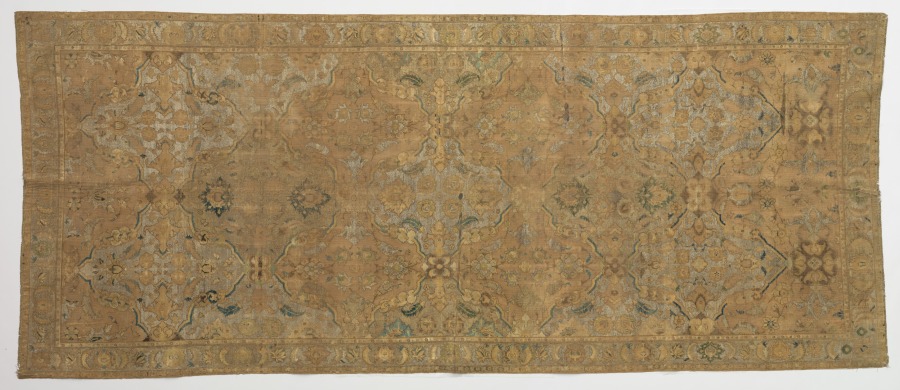
Isfahan — the Safavid capital, and a byword for refinement. Nain is a twentieth-century arrival by comparison, in ivory and soft blue, often with silk highlighting the outlines. Qum is likewise modern and finely woven, frequently in silk.
Josheghan holds to a diamond-lattice field that has barely changed in two centuries. Tehran, Varamin and Najafabad complete the central group.
The Arak region — Sultanabad, Mahal, Sarouk
This is the district that changed the modern rug trade. Sultanabad — now Arak — is where Ziegler & Co. organised production from 1880, and where the open-field, softly coloured style the world now calls classically Persian was shaped for Western rooms. Mahal is the more robust village grade of the same area; Sarouk the denser, floral one that dominated American imports for a generation. Lilian and Mir Saraband — the latter built from repeating boteh — belong to the same broad region.
Khorasan and the east
Mashad works in a deep madder red and a large medallion, with Mashad Sabzavar alongside it. Moud draws a fine all-over herati, and Kashmar is known for pictorial panels.
South and south-east
Kerman is the softest and most painterly of the Persian city weaves — floral, open, often pastel, and the source of much of the pictorial tradition. Yazd lies to its north.
Tribal and nomadic
Bakhtiari is our largest tribal holding: the garden-panel khesti layout, drawn as a grid of compartments, from the Zagros. Qashqai, Shiraz, Yalameh and Afshar are the confederation weaves of Fars and the south-east, and Gabbeh the thick, sparely drawn nomadic pile.
By condition — where the collection concentrates
Our most significant Persian pieces are grouped by age and grade rather than by town: Persian Masterpieces, Antique and Vintage. These are the rugs people come to the showroom to see.
One name that is not Persian. We also carry Khotan rugs, and they are often shelved with Persian weaves in the trade. Khotan is in East Turkestan — today Xinjiang, in western China — and its weaving is a distinct tradition with its own history. We keep it separate, because the label should tell you where a rug is from.