Rug Encyclopedia · Indian Rugs
An Indian rug is a rug hand-knotted or hand-woven in India — a first-rank carpet tradition in its own right, with a Mughal court lineage running back to the sixteenth century, and today one of the largest and most varied weaving industries in the world.
What is an Indian rug?
An Indian rug is a rug made in India — and unlike some producing countries, India is not a latecomer reproducing other people’s designs. It is one of the founding centres of the classical carpet. Court workshops were established under the Mughal emperors from the sixteenth century, and Agra in particular became a byword for carpets of extraordinary drawing and density. Indian weaving has an unbroken line from that court production to the workshops operating today.
That history is worth knowing because it changes how you read a modern Indian rug. When an Indian workshop weaves a Persian or Caucasian design, it is not a country borrowing prestige it lacks — it is a country with its own claim to the tradition, working in a shared visual language.
The Mughal inheritance
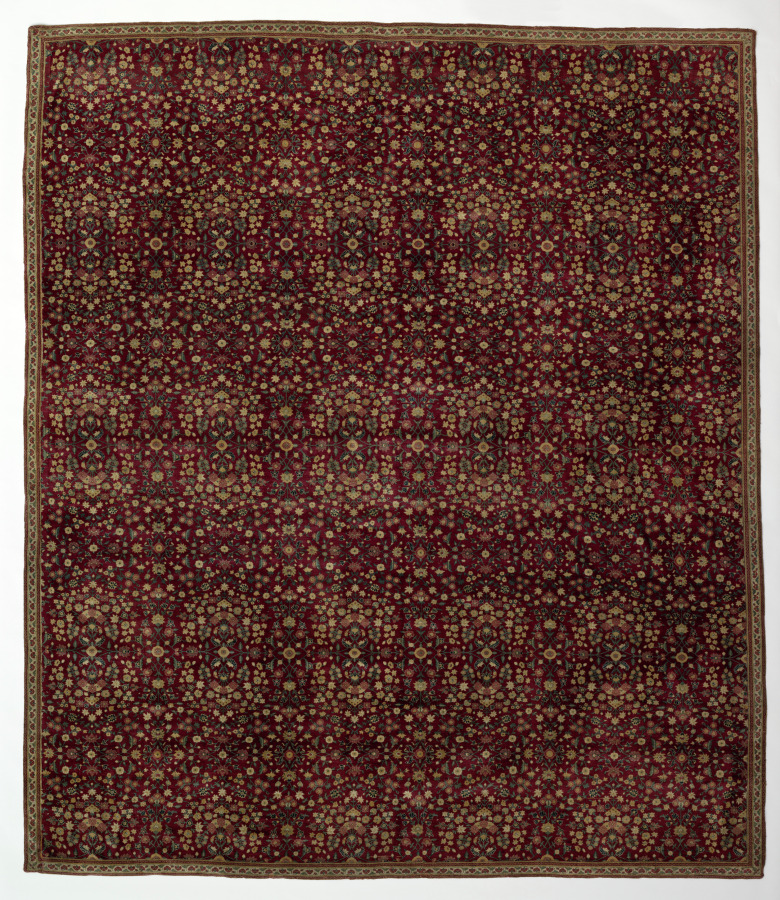
Carpet weaving in India was established on a court footing under Mughal patronage, and the workshops of that era produced some of the most finely drawn carpets ever made — dense, curvilinear, botanical, and utterly distinct from the geometry of the tribal traditions further west. Agra remains the name most closely attached to that lineage, and an Agra-design rug still carries its formal, garden-drawn character.
⚠️ A note on borders: much of what is called “Mughal” carpet production happened across a region that today spans India and Pakistan. Lahore was a Mughal capital. As with the Afghan/Pakistani story, a modern border runs through the middle of an older tradition — and we label rugs by the country they were actually made in, not by the empire that once contained it.
The Indian rugs we carry
- Agra (guide) — the classical Indian city weave: formal, floral, densely drawn.
- Indo-Ziegler — the Ziegler design idiom, woven in India. Open fields, soft palettes, large-scale drawing. The design lineage is Persian by way of a nineteenth-century British firm; the weaving is Indian, and we say so.
- Lori Baft (guide) — soft, plush, plainly drawn rugs, hand-made in India. Note the construction word: hand-made, not hand-knotted.
- Persian-design weaves — Tabriz, Sarouk, Herati and Polonaise drawing, woven in India.
Hand-knotted, hand-made, hand-tufted — India is where this matters most
India produces the full range of construction methods, and the words are not interchangeable. This is the country where a buyer is most likely to meet all three, so it is worth being precise:
- Hand-knotted — every knot tied by hand around the warp. Turn it over: the design shows through knot by knot, and you can pick out individual knots with a fingernail.
- Hand-made / hand-woven — made by hand, but not by knotting. Flatweaves and some plush constructions sit here.
- Hand-tufted — yarn punched through a backing cloth with a tool, then held in place with glue and a second cloth backing. It is quick, it is much cheaper, and it is not a hand-knotted rug. The giveaway is the back: a hand-tufted rug hides its structure behind fabric.
We state the construction on every product page, because between those three sits most of the confusion in the rug market — and most of its dishonesty. See hand-knotted vs hand-tufted vs machine-made.
Program collections — and one thing we will always tell you
Alongside one-of-a-kind pieces, we are bringing in program collections from India: designs produced as repeatable lines, in set sizes and colourways, so that a piece can be re-ordered or matched.
Program goods are restocked. One-of-a-kind pieces are not. Those are two genuinely different things, and we will never blur them: a program rug is described as a program rug, and the phrase “one of a kind” is reserved for pieces where it is literally true. If you want a rug nobody else can own, we will point you at one. If you want to furnish three rooms consistently, or match a piece you already have, a program line is the better answer — and there is no shame in either.
Frequently asked questions
Are Indian rugs good quality? The range is very wide — wider than in most producing countries. India makes some of the finest hand-knotted carpets available and also the bulk of the world’s hand-tufted goods. Quality is a question about the individual rug, not the country: read the construction, the wool and the back.
Is an Indo-Ziegler a real Ziegler? It is a real rug in the Ziegler design tradition, hand-knotted in India. “Ziegler” names a design idiom that began with a Manchester firm operating in Persia in the 1870s and 80s — it has never been a place. We tell you the design and the country separately, because they are separate facts.
Why do some Indian rugs cost far less? Usually construction. A hand-tufted rug takes a fraction of the time a hand-knotted one does, and the price reflects that. Neither is dishonest; describing one as the other is.