Oushak Rugs — A Complete Guide to the Soft-Palette Classic, History & How to Choose One
By Arteverk Atelier·
Rug Encyclopedia · Turkish Weaving
An Oushak rug is a hand-knotted wool rug in the classical tradition of Uşak in western Turkey — softly drawn, large in scale, and coloured in the muted, decorator-friendly palette that has made it the “quiet luxury” oriental rug. You know one by its soft gold, terracotta and rose tones, its open angular florals and medallions, and a lustrous, low-to-medium pile tied with the symmetrical (Turkish) knot.
Oushak rug — key facts
Design origin: Uşak (Ushak), western Anatolia, Turkey — a classical golden age from the 15th–17th centuries · Woven today: Turkey, Afghanistan, Pakistan & India · Material: lustrous hand-spun wool on a cotton foundation · Knot: symmetrical Turkish (Ghiordes), low-to-medium pile · Palette: soft gold & saffron, terracotta, salmon/rose, soft blue, ivory — muted vegetable-dye tones with natural abrash · Sizes: scatter & runners through room sizes to oversize & palace, 12'×15' and larger.
An Oushak rug — also spelled Ushak — is a hand-knotted wool rug whose design language comes from the town of Uşak in western Anatolia, Turkey, one of the oldest and most celebrated weaving centres in the world. The name marks a design tradition, not a single village or a modern country. Weavers build it on a cotton foundation with the symmetrical Turkish knot, then keep the pile low-to-medium so the large, softly drawn pattern reads clearly. Two things separate an Oushak from most other oriental rugs on sight: the drawing is big and open — angular florals, palmettes and medallions with room to breathe rather than a crowded, busy field — and the colour is muted and mellow, soft gold and terracotta and rose instead of saturated jewel tones. It was the great decorator’s rug of the Renaissance, and it still reads as understated luxury today.
A hand-knotted Oushak rug from the Arteverk collection.
What makes a rug an "Oushak"?
Soft, faded palette. Muted soft gold, saffron, terracotta, salmon, rose and soft blue against ivory — decorator neutrals that read as calm and mellow rather than loud. This gentle colouring is the Oushak signature.
Large-scale, softly drawn design. Open angular florals, palmettes and medallions spaced generously across the field. Bigger and calmer than a fine Persian rug, by design — a pattern you take in at a glance.
Lustrous wool. Knotted in glossy, high-lanolin Anatolian-style wool with a low-to-medium pile that catches the light and gives Oushaks their characteristic soft sheen.
One of a kind. Each hand-knotted Oushak is woven by hand with natural abrash; no two are identical.
Hand-knotted Oushak vs power-loomed — read this before you buy
The single most important thing to check when buying an Oushak is how it was made. Two rugs can share the same soft, large-scale design and look alike, yet be completely different objects — and we label them honestly.
Hand-knotted Oushak
Tied by hand, knot by knot, in lustrous wool — hand-knotted in Turkey, Afghanistan, Pakistan or India, new, and one of a kind. It ages beautifully, can be repaired, and is an heirloom. This is the heart of our Oushak collection.
Power-loomed Oushak
Machine-woven with an Oushak-style design. A budget-friendly way to get the soft, faded look, but it is not hand-knotted, not one-of-a-kind, and won’t wear or age the same way. We always label it power-loomed, never "hand-knotted."
Both are honest choices — they just aren’t the same thing. To know which you’re getting, check the Construction field on each product page; it states hand-knotted or power-loomed plainly. See our guide to power-loomed rugs if that is what you are after.
A hand-knotted Oushak rug from the Arteverk collection.
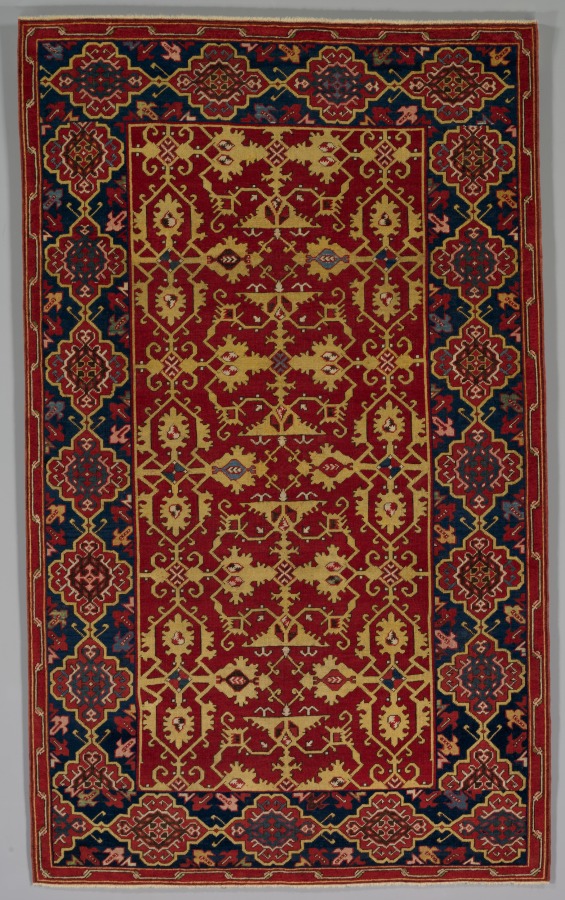
Classical Turkish carpet with the Lotto pattern. Turkey, Ushak, Ottoman period, 1600–1650. Cleveland Museum of Art, 2015.61. The “Lotto” group is named for Lorenzo Lotto, who painted carpets like it — a nineteenth-century collectors’ convention, not anything the weavers would have recognised. Open Access (CC0).
Where do Oushak rugs come from?
Oushak rugs originate in Uşak (Ushak), a town in western Anatolia in what is now Turkey. It is one of the oldest and most celebrated Turkish weaving centres, with a classical golden age running from the 15th to the 17th centuries — the era of the great Star and Medallion Ushaks that appear woven into Renaissance paintings by Holbein, Lotto and their contemporaries. Where they actually went is better documented than the trade usually admits. Ushak carpets furnished mosques — four sixteenth-century examples were recovered from two named mosques at Ayaş, and a fragment turned up in the Eşrefoğlu Mosque at Beyşehir in 1932 — and they were woven in quantity for export to Europe, where they appear under a Venetian doge’s throne in Paris Bordone’s painting of 1534, in a portrait of Henry VIII, and bearing the arms of the Genoese Centurione family. Whether Ushak also supplied the Ottoman court is genuinely disputed: the Metropolitan Museum treats Ushak as a place where Istanbul court style spread to, rather than a court supplier, and even Britannica concedes Ushak quality “probably never” matched the carpets made nearer the capital. We say mosques and European palaces, because that is what the surviving carpets show. That classical reputation is why “Oushak” still signals decorator-grade quality centuries later. Today, alongside continued weaving in Turkey, Oushak-style rugs are also hand-knotted in Afghanistan, Pakistan and India, where workshops reproduce the soft palette and open drawing using hand-spun wool and vegetable dyes.
What are the classical Oushak sub-types?
Oushak is a family, not a single pattern — the classical looms of Uşak produced several distinct types, and their names are still used to describe the design today.
Star Ushak — Rows of large, eight-pointed star medallions alternating down the field; one of the two great classical types, 15th–16th century.
Medallion Ushak — A single large central medallion, often lobed and ogival, floating on an open field of vine scrolls; the other defining classical type.
Bird Ushak — A white-ground repeat whose leaf-and-rosette motif was read by European eyes as a stylized bird; 16th–17th century.
Lotto Ushak — A yellow lattice of angular arabesques on a red ground, named after the painter Lorenzo Lotto, who painted such rugs into his portraits.
White-ground & Ghiordes variants — Ivory-field Ushaks and related western-Anatolian Ghiordes weaves, prized for their luminous open grounds.
Angora / soft-colour Oushak — Modern revivals woven in especially soft, muted palettes and lustrous wool for today’s transitional interiors.
A weaver tying knots by hand on the loom — months of work in every rug.
Colors, natural dyes & the faded palette
Soft gold & saffron — the warm, mellow yellows from weld and vine that give many Oushaks their sunlit base.
Terracotta & salmon/rose — soft madder-derived reds, dusty and warm rather than bright; a classic Oushak field colour.
Soft blue — restrained indigo, muted and greyed rather than deep navy, keeping the palette calm.
Ivory — undyed natural wool used for open grounds and to let the soft colours breathe.
Abrash is the tell that separates hand-dyed from industrial: the subtle horizontal striation where a weaver moves from one vegetable-dye batch to the next. On a genuine Oushak, abrash is not a flaw — it is a fingerprint, and part of why these rugs read as softly variegated and gently faded rather than flat.
How are Oushak rugs made?
Oushak rugs are hand-knotted with the symmetrical Turkish (Ghiordes) knot on a cotton foundation, using lustrous hand-spun wool kept at a low-to-medium pile so the large, open drawing stays legible. The wool’s high lanolin content is what gives an Oushak its soft sheen and its ability to age gracefully — the surface mellows and gains character rather than wearing out.
Classic Oushak
Fine / soft-colour Oushak
Knot type
Symmetrical (Turkish)
Symmetrical (Turkish)
Knot density
Low-to-medium, bold drawing
Medium, finer detailed drawing
Drawing
Open, large-scale florals & medallions
Finer vine work, softer medallions
Wool & dye
Lustrous hand-spun wool, muted dyes
Selected lustrous wool, all-vegetable dyes
Soft-colour and "Angora" Oushak are palette and quality descriptors, not a separate origin or collection. They sit inside the Oushak collection as pieces of the same craft.
What sizes do Oushak rugs come in?
Category
Typical dimensions
Best for
Scatter / small
2'×3' to 4'×6'
Entryways, bedside, layering
Runner
2.5'×8' to 3'×14'
Hallways, galley kitchens, staircases
Area (small)
5'×7' to 6'×9'
Seating areas, smaller living rooms
Area (standard)
8'×10' to 9'×12'
Living and dining rooms
Oversize
10'×14' to 12'×15'
Great rooms, open-plan living
Palace
12'×18', 14'×20' and larger
Grand halls, double-height & commercial spaces
Fringe is part of the foundation and is never counted in the stated dimensions. Oushak designs suit large rooms especially well — the open, large-scale field scales up gracefully. Arteverk carries oversize and palace Oushaks — 12'×15' and up — including pieces held in inventory beyond what’s currently listed online, so ask us if you need a specific large size.
How can you tell if an Oushak is authentic and hand-knotted?
Read the back. The pattern shows clearly on the reverse and individual knots are visible. A uniform, gridded, or glued back means machine-made.
Look for symmetrical knots. Slight knot-to-knot irregularity is correct; perfect machine uniformity is not.
Find the abrash. Subtle color striation signals hand-dyed wool; dead-flat color suggests chemical dye or a print.
Feel the wool. Lustrous hand-spun wool feels slightly uneven and lanolin-rich with a soft sheen; synthetic feels plasticky.
Check the fringe. On an authentic rug the fringe is the warp — not a separate strip sewn or glued on.
Accept small irregularities. A hand-drawn medallion that isn’t perfectly mirror-symmetric is a human weaver’s mark, not a defect.
Oushak vs Persian vs Ziegler
Oushak
Persian (classic)
Ziegler
Design origin
Uşak, western Turkey
Iran
Persian Sultanabad, softened for the West
Woven today
Turkey; Afghanistan, Pakistan, India
Iran; India, Pakistan
Pakistan, Afghanistan
Knot
Symmetrical (Turkish)
Mostly asymmetrical
Symmetrical or asymmetrical
Design
Soft, large-scale florals & medallions
Dense curvilinear florals
Open, large-scale soft florals
Palette
Muted soft gold, terracotta, rose, ivory
Wide, saturated jewel tones
Muted, earthy decorator neutrals
Oushak and Ziegler are the two most cross-shopped soft rugs, because both offer a muted, decorator-friendly palette. The split is heritage and knot: an Oushak is a Turkish design tied with the symmetrical knot, while a Ziegler is a Persian Sultanabad design softened for the Western market. Against a bold, tribal Kazak — which shares the same symmetrical Turkish knot — the contrast is style: the Oushak is soft, large-scale and mellow where the Kazak is bold, geometric and high-contrast.
How to choose an Oushak
Because their colour is muted and their drawing open, Oushaks are the natural choice for transitional and modern interiors — rooms where you want the warmth and craft of an oriental rug without a loud, busy pattern competing with the furniture. The soft gold and rose grounds flatter both warm and cool schemes, and the large scale reads as calm rather than fussy under contemporary pieces. Choose a lighter ivory or soft-gold ground to open up a room and lift the light; choose a terracotta or salmon field to add quiet warmth. In big, open-plan spaces the large-scale design comes into its own, so size up rather than down where you can.
Care & maintenance
Vacuum weekly, gently — suction without a hard beater bar, in the direction of the pile. Never vacuum the fringe.
Rotate every 6–12 months to even out sun fading and foot traffic.
Use a rug pad to reduce slippage and cushion the knots against grit.
Blot spills immediately with a clean white cloth, outside in. No harsh detergents or bleach.
Keep out of constant direct sun — vegetable dyes are stable but not sun-proof.
Deep-clean professionally with a wool hand-wash specialist. See our rug care guide.
Are Oushak rugs a good investment? The Arteverk Value Ladder
Antique classical Oushaks are established collector assets; modern hand-knotted Oushaks are durable, decorative value rather than speculation. Higher knot density, better lustrous wool and all-vegetable dyes, larger sizes, cleaner drawing, and age push value up; wear, repairs, and synthetic dyes push it down. Every rug we appraise is read against our six-rung Value Ladder — use it as your own checklist. For current selection across sizes, see the Oushak collection.
Our six-rung framework for judging any hand-knotted rug.
Real makers, real curators. Arteverk is run by the Malik family — third-generation weavers and curators who commission, curate, and restore hand-knotted rugs woven in origin workshops.
The exact piece you see. Every hand-knotted Oushak is photographed as the single, one-of-a-kind rug you’ll receive — never a stand-in image.
Honest labeling. Turkish in design, woven in Turkey or South Asia, stated plainly; any power-loomed piece is labeled power-loomed, never "hand-knotted."
Find your Oushak
Browse our hand-knotted Oushak rugs, or tell us your size and colors and we’ll hand-pick a few one-of-a-kind pieces for you.
oushak rugturkish oushak rughand knotted oushaksoft color oushakoversize oushak rugmuted persian rug alternativestar oushakvintage oushak styleivory oushak rugone of a kind rug
Frequently asked questions about Oushak rugs
What is an Oushak rug?
An Oushak rug is a hand-knotted wool rug in the classical Turkish tradition of Uşak in western Anatolia, known for its soft, faded palette of gold, terracotta and rose, its large-scale open florals and medallions, and its lustrous wool. It is tied with the symmetrical Turkish knot and is woven today in Turkey, Afghanistan, Pakistan and India.
Are Oushak rugs Turkish or Persian?
Oushak rugs are Turkish. The design originates in the town of Uşak in western Anatolia, Turkey, one of the oldest weaving centres in the world, with a golden age from the 15th to 17th centuries. They are often compared to Persian rugs because of their soft palette, but they are a distinct Turkish tradition using the symmetrical Turkish knot.
Are Oushak rugs hand-knotted?
Authentic, traditional Oushak rugs are hand-knotted wool, tied knot by knot with the symmetrical Turkish knot on a cotton foundation. At Arteverk, hand-knotted Oushaks are the heart of the collection; any power-loomed Oushak-design rug is clearly labeled power-loomed. The Construction field on each product page states which it is.
Why are Oushak rugs so popular?
Because their soft, faded palette and open, large-scale drawing suit transitional and modern interiors — they bring the warmth and craft of an oriental rug without a loud, busy pattern. That “quiet luxury” look, combined with a celebrated classical heritage, makes the Oushak a long-standing decorator and designer favourite.
What is the difference between an Oushak and a Ziegler rug?
Both offer a soft, muted, decorator-friendly palette, but they come from different traditions. An Oushak is a Turkish design from Uşak, tied with the symmetrical Turkish knot; a Ziegler is a Persian Sultanabad design that was softened and opened up for the Western market in the 1880s. The Oushak tends to feel more classical and Anatolian, the Ziegler more all-over floral.
How much do Oushak rugs cost?
Modern hand-knotted Oushaks vary by size, knot density, wool and dye quality, from small scatters and runners up to oversize and palace pieces of 12'×15' and larger. For current selection and pricing across sizes, see the Oushak collection. Antique classical Oushaks are a separate collector market.
What sizes do Oushak rugs come in?
From small scatters (2'×3') and runners through standard area sizes (8'×10' to 9'×12') up to oversize and palace pieces of 12'×15' and larger. The open, large-scale design suits big rooms especially well, and fringe is never counted in the stated dimensions.
How do I clean an Oushak rug?
Vacuum weekly without a beater bar and avoid the fringe, rotate every 6 to 12 months, use a rug pad, and blot spills immediately with a clean white cloth. For deep cleaning, use a specialist who hand-washes wool rather than a general steam service.
Are Oushak rugs good quality?
Yes. Good hand-knotted Oushaks use lustrous hand-spun wool and vegetable dyes at low-to-medium knot density, with a pile that ages gracefully and gains a soft sheen. Quality varies with wool, dye and density, which is why we read every piece against our Value Ladder and label construction honestly.
What colors do Oushak rugs come in?
The Oushak signature is a muted, faded palette: soft gold and saffron, terracotta, salmon and rose, soft blue, and ivory. The tones are gentle and decorator-friendly rather than saturated, which is what gives Oushaks their calm, quiet-luxury look and their versatility across warm and cool interiors.
Our Afghan interpretation of the Oushak design. Woven on our own looms — the pattern follows the Oushak tradition, the rug is Afghan. In the trade rugs like this are called Ziegler, Chobi or Peshawar rugs, and they sit alongside the originals as oriental rugs. Browse the Oushak collection · see this rug
Tell us the space and we’ll put together a short, curated edit from the
pieces we actually have — not a catalogue to wade through.
Arteverk · In rugs since 1970
10% off your purchase.
Hand-knotted, one of a kind, and priced by the family who has sourced them
since 1970 — not by a showroom three markups down the line.
Add your email and we’ll send the code with your edit.
Free U.S. shipping
Free returns
30‑day returns
One code per customer. By subscribing you agree to our
Privacy Policy and
Terms, and to receive email from Arteverk.
Unsubscribe at any time.